
All of you know I’ve been writing and publishing poetry for decades. My first collections were published in 1991. And even if you’re new here I assume you know I must write a few other things too, such as fiction — mostly flash and short stories — some nonfiction, etc. Actually, I’ve written any many other areas and genres and my Wikidata profile even lists 10 genres for me as a professional writer (these all have to be vetted/confirmed via references and qualifiers from their list of “acceptable” sources). These include
- poetry
- literary criticism
- science fiction
- horror literature
- book review
- political criticism
- journalism genre
- fiction literature
- non-fiction
- experimental poetry
Other genres should probably be included, technically, but I doubt anyone really cares and no one will lose sleep over it. But did you notice the second one — literary criticism? Google Scholar doesn’t give me much credit, and people have complained for years that they don’t allow for corrections or additions or anything so most everyone has who knows how many crucial citations out there not reflected in Google Scholar. Nice. However, I’ve done pretty well in that category and indeed once thought it was my strongest feature. I have never had a paper of literary criticism rejected or turned down on submission to conferences or academic journals, including juried ones. Which makes me wish I had had more opportunity to research, write and publish a lot more of them with that track record.
Back around the year 2000, I signed a tiny contract with a huge educational textbook publisher in which I thought I agreed to sell the non-exclusive reprint rights for one of their (many) series, WITH the option to reprint in future editions of the series. It was a paper on Yeats. I believe I ended up selling two different Yeats papers. The first textbook I think I recall having one of my essays in came out around 2003 and was titled Literature: An Introduction to Fiction, Poetry, and Drama 3rd Compact Edition, edited by XJ Kennedy and Dana Gioia in hardback with a CD, published by Longman in New York. Longman was also known as Longman Pearson, now just Pearson which has gobbled up numerous smaller publishers and have a huge part of the educational curriculum market.
I virtually gave away my original research for little more than an honorarium, but thought it was a good career move because it would be read by a huge group of people, could influence future opportunities, and would theoretically get me opportunities nothing else would in that area. (I was teaching and thinking of making it permanent.)
Long story short, though, is I didn’t do any serious research to find out how many different, yet nearly identical series those companies had, and it turns out a lot — I still don’t know. And yeah, they put out new editions nearly every year. Books that can cost hundreds to thousands each. They put out other related things like digital-only versions, instructor’s manuals to the books, etc. I was never paid again because I had agreed to let them reprint my essays, but I swear I believed it was only for that one original series and only a couple of reprints — certainly not every damn year, and we’re talking plausibly dozens of nearly-identical huge expensive books every year, presumably all with one or more of my critical essays, meaning I have no damn idea how much money they make on those series each year, and I can’t even guess, but if there are…
———————
No point in guessing or going down that road. Let’s just say that the last two years, Pearson’s revenue fell to a rough average of £4 Billion annually. I doubt those specific textbooks made a huge total of that and since these textbooks have a number of different such contributions from scholars on different writers, there were a lot of people to pay. Once. Since then? They’ve made billions a year and I never even made close to $1,000 total, nothing since.
OK, now that that occasional bitterness has been addressed, I’ve never been notified about reprints, other series or books or anything. In fact, the only way I’ve ever found out has often been by my name turning up in class syllabi at schools using these textbooks that write one of those Yeats poems AND the critical essay that goes with it into the syllabus, such as Western Kentucky University as one example. I’ll also find other mentions in Google Books and elsewhere but the books have gotten so big that they often no longer include everyone in the main TOC, creating a secondary one for the critics, who then can’t be found via Internet searches. The point is I’ve seen very few textbooks I’m allegedly in and I can only guess how many that number might be, but it’s got to be in the hundreds. Yet I’ve rarely been able to confirm for myself because I can’t afford to get most any, and even if I could, it’s nearly impossible to find used copies anywhere. Often when you do, they’ll either not indicate my name so why waste money in buying it even if cheap or like one I saw last week, a used copy was approaching 5 figures. Right.
So the point of this otherwise pointless post is I actually found two or three “new” (to me) textbooks I didn’t know about or have with my name in the TOC and at least one of my essays in them because thanks to the wonderful Internet Archive, they’ve got digitized versions of the whole damn books and I could check ’em out. I even found a used one for sale for about $12 and it should be arriving next week. I actually don’t have any copies of not only most of the textbooks, but dozens of anthologies and even some of my own books! So any I can find is precious to me. (Proof I existed?)
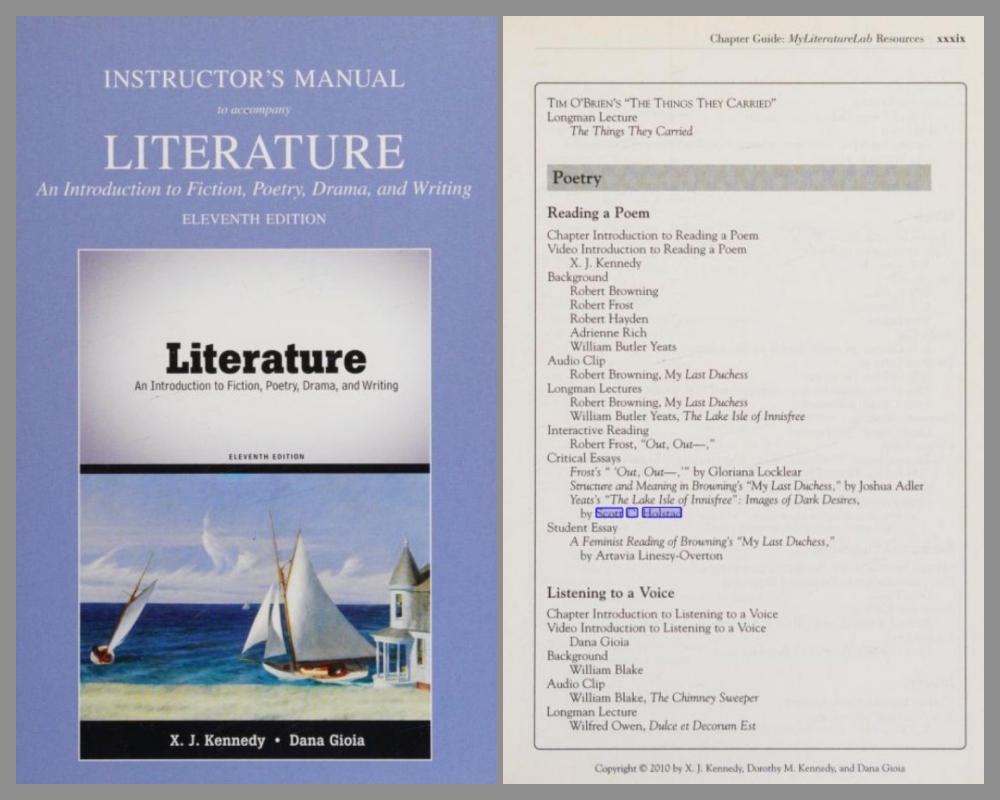
So I’m finally going to both get to the literal point AND end of this post. Titles and pics of two textbooks from 2010 and 2012 that are “new” to me, that I can add to my vita and other documents, and feel a little more satisfaction at actually seeing something tangible proving my efforts went to something, even if the money didn’t go to me. When you’re a writer, it’s the little things all too often. Here they are.
Instructor’s Manual to Accompany Literature: An Introduction to Fiction, Poetry, Drama, and Writing, 11th ed. Eds Kennedy, X. J., et al. Pearson Longman, 2010.
Instructor’s Manual to Accompany Literature for Life. Ed Kennedy, X. J. Pearson, 2012.

OK. Anticlimactic? I’m sorry. I’m sure no one cares but me but it’s good to find a couple of real, confirmable examples of some of my work out there I didn’t know about. Even if that’s all it is. I have no one to tell about or share this with, so I’m doing so here but I’ll understand when people move on to the topic I hope to post about next, perhaps tomorrow or this weekend. It’s pretty big, exciting news.
Cheers, Scott Holstad

 hankrules2011